
Xeno Co-Lab
Supporting service design research in India and Indonesia by bringing multilingual qualitative evidence into one analysis workflow
Service Design, Social Innovation
Design research

Dots supports the research process from end to end, rather than requiring multiple tools. As more interviews and annotations were added, the data remained organized. The workspace evolved alongside our thinking, so instead of repeatedly reorganizing information across different platforms, we could continue building on the same body of work.



About the partner
Xeno Co-lab is a service design and social innovation consultancy that helps organisations create unique and localized products, services, and experiences. Working with a global network of partners and consultants, they bring together a knowledge base of cultures, context, and domain expertise to deliver end-to-end research and design solutions that create meaningful, sustainable impact for people and businesses.
Outcome of the study
Dots enables Xeno Co-lab to synthesize rich, multi-market insights into a cohesive picture of Gen Z’s online content consumption and sharing behaviors, surfacing opportunity areas and actionable recommendations that feed into the client's product roadmap, helping them drive deeper engagement and grow their user base across India and Indonesia.
Needs for Xeno Team
1
Handle multi-language, multi-format data ingestion such as audio/transcripts in English and Hindi from India, and pre-translated Bahasa transcripts from Indonesia
2
Enable flexible, multi-lens tagging and pulling data across different lenses like region, gender, behavior, and platform usage to find patterns across a large qualitative dataset and surface behaviorally contradictory outliers that deviate from dominant patterns
3
Support emergence of behavioral personas from the data, and allow iterative refinement of platform context as the project progresses, particularly after the pre-task phase
Solution Snapshot
1
Survey-based pre-task collection to capture multi-format participant stories and behaviors in one place
2
Automated translation and transcription that made Bahasa Indonesia data readily reviewable in one connected view
3
AI-assisted multi-lens thematic tagging and meta-tag filtering to organize participant responses and compare behaviors across segments.
4
Conversational querying with Ask AI to quickly understand broad sentiment, generate directional summaries, and reduce manual review across annotations and source documents

Multi-format, multilingual data collection
Gather long-form text, images, and audio/video from participants across India and Indonesia in one place
A smooth, low-friction pre-task experience that translated cleanly across both markets and captured rich baseline behaviours

Built-in translation & transcription
Automatically transcribe and translate submissions across English, Hindi, and Bahasa Indonesia
Easy and hassle-free multilingual data review enabling market analysis in a single, consistent view

Multi-lens thematic tagging
Organize data into a 3-tier system (themes, sub-themes, and tags) and filter across lenses like region, gender, subscription type, and platform usage
Identify patterns across a large qualitative dataset and behaviorally isolate contradictory outliers

AI-assisted Highlights
Use AI-assisted annotations to tag participant responses and review, filter, and summarize them in one place using Highlights
Makes large qualitative datasets faster to analyze by automating the annotating process while maintaining analyst oversight
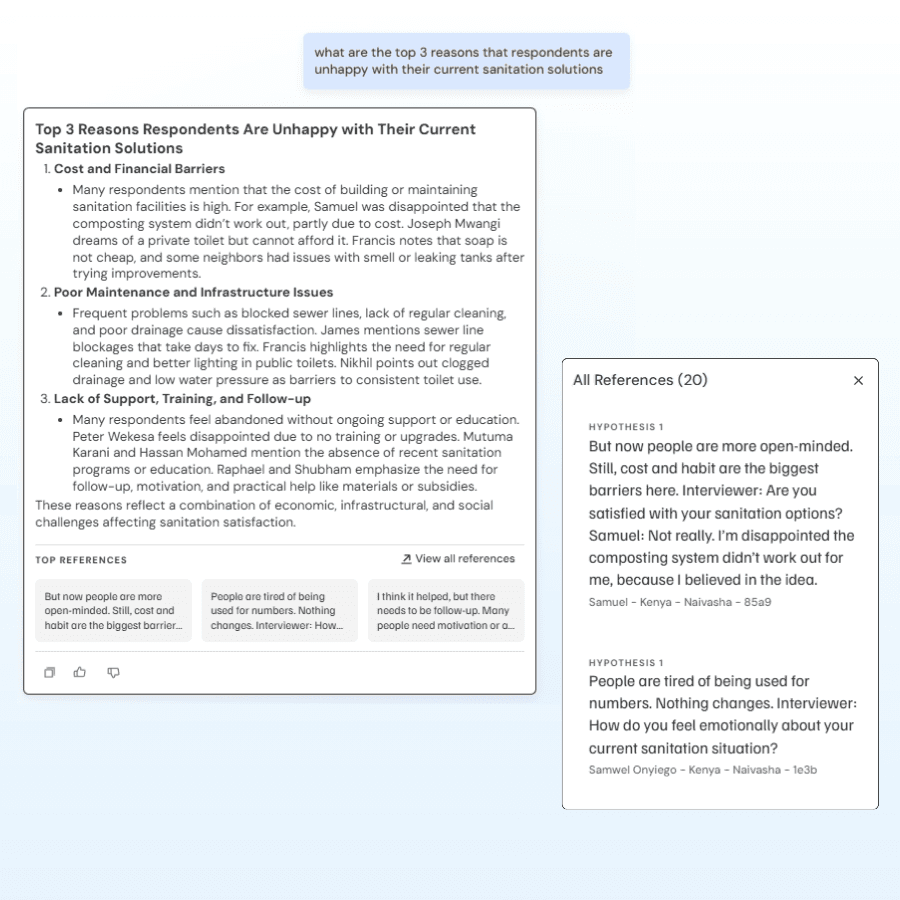
Ask AI
Query the dataset conversationally to explore participant responses and discover emerging themes
Accelerates early exploration across the full dataset by quickly surfacing broad sentiment and generating directional summaries
Structuring qualitative data is usually a time-consuming process, especially when themes evolve as your understanding develops. The tagging system gave us enough structure to organize observations early on, while still allowing us to refine and reorganize tags as our thinking evolved. That flexibility matched the way qualitative analysis naturally progresses.