
Khoj Studios
Understanding artist experiences and evolving needs across Khoj’s programs and cohorts
Contemporary Arts, Arts & Culture, Not-for-profit
Program & Leadership team



About the partner
Khoj is a not-for-profit contemporary arts organization based in New Delhi that supports and incubates emerging and experimental artists through residencies, fellowships, workshops, and other programmes. Its programmes create space for artists to experiment, develop their practices, and engage in dialogue and exchange with other artists and practitioners across disciplines.
Outcome of the study
Dots enables Khoj to synthesize insights across participants and alumni into a cohesive picture of how artist and residency needs are evolving, and identify emerging gaps Khoj could address in the future. It also helps Khoj gauge its long-term influence by examining how its alumni contribute to strengthening the broader arts and cultural ecosystem.
Needs for Khoj Team
1
Bring together feedback from five programs, each with its own structure and format, ranging from Google sheets to handwritten notes
2
Enable analysis of open-ended feedback from programs that do not fit traditional impact-evaluation frameworks, while preserving the nuance and context within responses
3
Move beyond reviewing each year’s cohort in isolation towards cross-program and cross-cohort comparison to identify patterns and emerging opportunities
Solution Snapshot
1
Separate, structure-preserving dataset imports for each program, allowing Google Form responses and digitized handwritten forms to sit in the same system without forcing one structure onto the other
2
A common metadata schema applied across all five datasets, connecting evidence across programs, and allowing filters to surface relevant responses across all datasets
3
A flexible thematic framework built around Khoj’s ‘Art&’ curatorial methodology, with the ability to adapt the framework as the team’s understanding of the data develops.

Direct data import
Import data from each of the five programs and its cohorts, while preserving the original structure and format
Brought data from across programs and cohorts into one place, making it possible to analyse the full dataset together without losing the context of individual programs
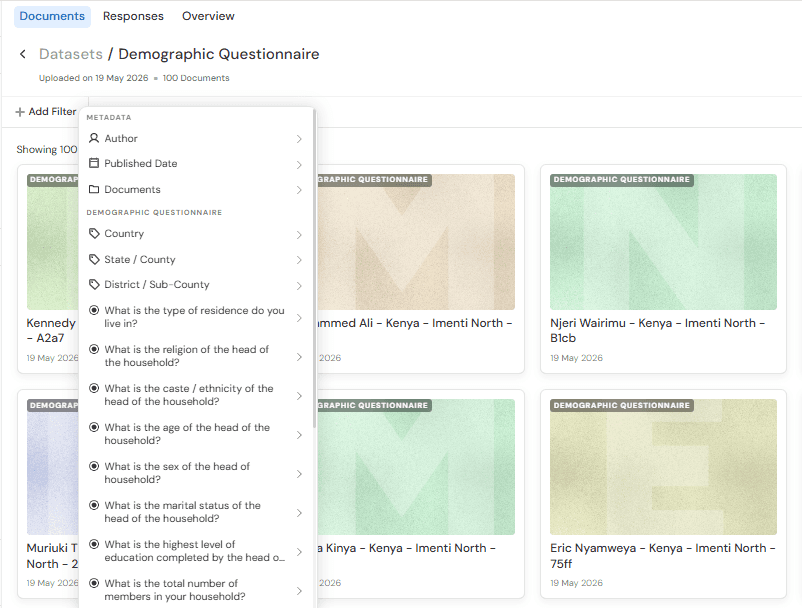
Common Metatag Architecture
Shared metadata fields connect evidence across all five datasets, allowing the same data points to be filtered consistently across programs and cohorts
Apply a single filter across multiple datasets to surface connected evidence and identify insights that would remain fragmented when each dataset is analyzed separately

Custom Themes Manager
Build a flexible thematic framework around Khoj's ‘Art&’ curatorial methodology, with the ability to filter data across different lenses
Analyze feedback to surface artists’ needs, identify emerging opportunities, and assess where its programs and support systems are creating meaningful experiences

Highlights explorer
Bring all annotated evidence into one analysis space, slice by metadata or themes, and get summaries
Move from individual pieces of feedback to patterns across programs, cohorts, and participant groups